01252 615657
 fosterandheanes@gmail.com




Electric vehicles have become a familiar sight on UK roads, and for many drivers they offer a quieter, smoother and potentially more economical way to travel. But while EVs have fewer moving parts than conventional petrol and diesel cars, they are certainly not maintenance-free.
From charging problems and unexpected warning lights to changes in range and unusual noises, there are a number of issues that EV owners should take seriously.
The good news is that not every electric car problem means there's a fault with the high-voltage battery. Many issues can be diagnosed and repaired without anything like the expense of replacing a battery pack.
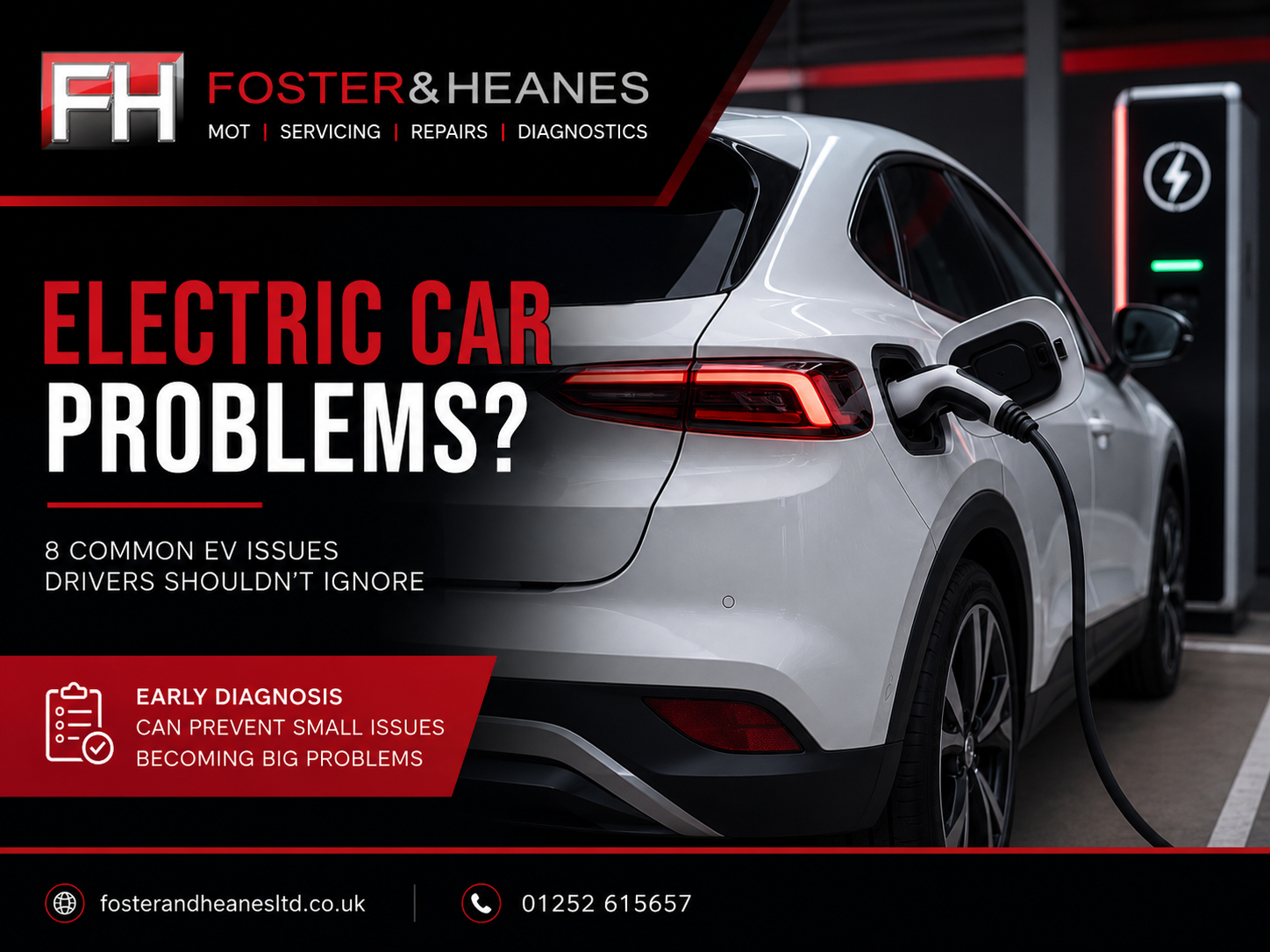
At Foster & Heanes, we provide electric vehicle servicing, diagnostics, MOTs and repairs, so we've put together this guide to some of the common EV problems drivers may encounter.
1. Your electric car isn't charging properly
One of the most frustrating EV problems is plugging your car in and finding that it isn't charging as expected.
You might notice:
- No charge at all
- Charging repeatedly stops and starts
- Charging is much slower than usual
- A warning appears on the dashboard
- The charging cable won't connect or release
- The vehicle charges successfully at one charger but not another
There can be several possible causes.
The problem might be with the charging cable, charging point or electrical supply, rather than the vehicle itself. However, faults with the car's charging system, onboard charger or other electrical components can also cause problems.
If you've ruled out an obvious problem with the charger or cable and your EV still isn't charging correctly, it's worth getting it professionally diagnosed rather than simply assuming the battery is at fault.
2. Your driving range has suddenly dropped
EV owners naturally keep an eye on their remaining range. A gradual reduction in range isn't necessarily a sign that something is wrong.
Range can be affected by:
- Cold or very hot weather
- Use of heating or air conditioning
- Driving at higher speeds
- Heavy traffic
- Driving style
- Tyre pressures
- Vehicle load
- Battery condition
However, if you notice a sudden or significant change in range, particularly if it doesn't correspond with changes in weather or driving conditions, it's worth investigating.
Don't immediately assume that the high-voltage battery needs replacing. There are numerous factors and systems that can affect EV efficiency and range, which is why accurate diagnostics are important.
3. EV warning lights shouldn't be ignored
Modern electric cars can provide drivers with a considerable amount of information through the dashboard.
Warning messages should not be ignored, especially if it’s the:
- High-voltage system light
- Battery light
- Charging system light
- Battery temperature light
- Motor or drivetrain light
Some warning messages may indicate a relatively straightforward fault, while others could point to a more significant electrical or mechanical issue.
If a warning light or message appears and remains on, arrange a diagnostic check rather than hoping it disappears.
The earlier a fault is identified, the better the opportunity to deal with it before it develops into a more expensive problem.
4. Your EV suddenly loses power
Electric vehicles are known for their instant acceleration, so a noticeable loss of performance can be particularly obvious.
If your vehicle suddenly feels sluggish, won't accelerate normally or enters a reduced-power mode, there could be several possible explanations.
The vehicle may have detected a fault and deliberately reduced its performance to protect a component or system.
This can potentially be related to:
- Battery temperature
- Electrical faults
- Motor or inverter problems
- Battery management systems
- Cooling system issues
- Other electronic components
If your EV suddenly loses power, don't continue driving normally and hope it sorts itself out. Follow any warning displayed by the vehicle and seek professional advice.
5. Unusual noises or vibrations
One of the things EV drivers quickly become accustomed to is how quiet their vehicles are.
That means unusual noises can sometimes be easier to notice. If you notice a new noise, such as a grinding noise, knocking, clicking or vibration, it may not be an electrical problem. Have it checked rather than assuming its simply part of how the car sounds.
6. EV brakes can still develop problems
Electric vehicles use regenerative braking to recover energy and return some of it to the battery. This means the conventional brakes may be used less frequently than on a petrol or diesel car.
However, brake discs and other components can still suffer from:
- Corrosion
- Surface rust
- Seizing
- Wear
- Reduced Braking performance
7. Tyres can wear faster than expected
Regular tyre checks and correct pressures are particularly important for EVs.
EVs can be relatively heavy because of their battery packs, while the instant torque from an electric motor can put additional demands on the tyres.
Incorrect tyre pressures, wheel alignment, suspension problems and driving style can all contribute to uneven or accelerated tyre wear.
Keep an eye out for:
- Uneven tread wear
- Excessive wear on the inside or outside edge
- Vibrations through the steering wheel
- Changes in handling
- Frequent loss of tyre pressure
If you notice unusual wear, don't simply replace the tyre without investigating the reason. A problem with alignment, suspension or steering could cause the replacement tyre to suffer the same fate.
8. Battery Temperature and Cooling Problems
Your EV's high-voltage battery operates within a carefully controlled temperature range.
Modern electric vehicles have sophisticated thermal management systems designed to keep the battery at an appropriate temperature.
Extreme temperatures can affect EV performance and charging, which is one reason you may notice changes in range or charging speed during periods of very hot or cold weather.
If your vehicle displays a warning relating to battery temperature or the cooling system, it should be investigated.
Cooling system problems can potentially affect more than just the battery. Depending on the vehicle, thermal management may also be important for other electrical components.
EV Diagnostics, Servicing & Repairs at Foster & Heanes
Not every EV problem means an expensive battery fault.
Warning lights, charging problems, reduced range, unusual noises or loss of power can have a number of causes, so getting the problem diagnosed early can help prevent a minor issue becoming a bigger repair.
Foster & Heanes offer EV diagnostics, servicing, MOTs and repairs, as well as general maintenance including brakes, tyres, suspension and air conditioning.
Getting your EV Regularly Serviced
Our EV servicing is designed to check the important components of your vehicle and identify potential problems before they become more serious.
Depending on your vehicle and manufacturer's requirements, an EV service can include checks of:
- Battery condition and related systems
- Charging system and electrical components
- Cooling and thermal management systems
- Tyres, steering and suspension
- Brakes and brake components
- Lights and other safety systems
- Air conditioning and heating
- Windscreen, wipers and fluid levels
- General vehicle condition and manufacturer-specific checks
We use up-to-date diagnostic equipment and technical information to ensure your EV receives the appropriate level of servicing for its make and model.
If you are having problems with your EV or wish to set up a regular service plan, please get in touch. Call Foster & Heanes on 01252 615657. Courtesy cars are available subject to availability, with free local collection and drop-off also available.